Wednesday, March 31, 2010

Granny Gomez and Jigsaw


Booklist (January 1, 2010 (Vol. 106, No. 9))
Preschool-Grade 2. Granny Gomez loves her big country house—there’s room for everything, from drums to jigsaw puzzles. Though she is sometimes lonely, a pet piglet is not what she had in mind for company. Yet soon Granny and pig are watching cooking shows together and even doing puzzles (hence Jigsaw’s name). As their friendship grows, so does Jigsaw, and he soon gets stuck in cabinets and in Granny’s bass drum, and he is eventually too big to push up the stairs. So Granny Gomez builds a barn that’s perfect for Jigsaw—including a big-screen TV, puzzle shelves, and a kitchen. But that night, in their respective abodes, each realizes something’s missing, and after some thinking, Granny finds a solution, bringing a happy resolution—and reunion. Descriptive, peppy text and colorful art expressively depict spirited, gray-bunned Granny and her personality-laden porcine pal. With folksy charm and witty details, this amusing story will make for read-aloud fun, providing a warm portrayal of pets as beloved companions, however little or big.

The Sixty-Eight Rooms


Booklist (January 1, 2010 (Vol. 106, No. 9))
Grades 4-6. Sixth-graders Ruthie and her best friend, Jack, are on a class visit to Chicago’s Art Institute, where they see the famous Thorne Rooms. Filled with incredible miniatures, the rooms, representing different time periods, fascinate Ruthie. When she finds a key that shrinks her and allows her to get inside the rooms, Ruthie wants to return as soon as possible. Jack is a willing partner, and when a way is found to shrink him, too, the adventure really begins. First-time novelist Malone carefully crafts a fantastical story with plenty of real-world elements, including Jack’s mother’s worries as she tries to make a living as an artist and the subplot of a museum security guard, who has lost something important. Jack and Ruthie find it in the rooms, which tie the past and present together. There are contrivances that make accessibility to the adventures possible, but readers will focus on the mystery, the history, and the excitement of being small.

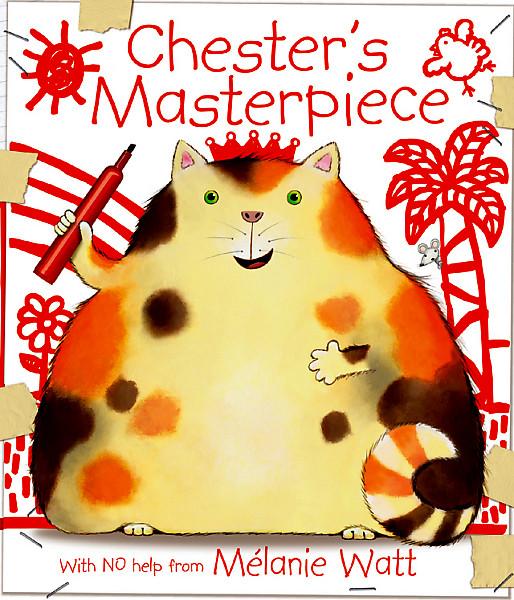
Chester's Masterpiece


Kirkus Review starred (January 15, 2010)
Chester, Canadian cat author extraordinaire, is back for a third self-aggrandizing volume without any help from Mélanie Watt. He has hidden her art supplies AND her computer mouse (which apparently tastes like chicken). He is in full control of this outing...unfortunately, she's found a pencil and some Post-it notes. Even though he tries to tell his story, she keeps interrupting to ask for her stuff back, while Mouse (who looks suspiciously like the human author) just keeps kibitzing. Still, Chester manages to tell the tale of Supercat saving the world from Dr. Meanmouse and one about Captain Cat surviving a whale attack, unlike poor Skipper Mouse. But then the unthinkable occurs: Chester's marker runs out of ink. Watt's chunky puss with delusions of grandeur (and writing skill) helms a sorta-meta-adventure sure to delight his fans. Chester appears in full watercolor while his own "illustrations" are in his trademark red marker. There are plenty of giggles along the way, and the author's revenge (not to mention Chester's hiding place for her supplies) will elicit gales of laughter. A must purchase, especially where the first two are loved. (Picture book. 4-8)

Cat the Cat Who is That?


Booklist (March 15, 2010 (Vol. 106, No. 14))
Preschool-Grade 1. Along with Let’s Say Hi to Friends Who Fly (2010), this upbeat title introduces young children to a new cast of animal pals. In large, bold type well-suited for brand-new readers, a narrator asks the title’s question as winsome Cat the Cat, in a sporty purple dress, says hello to her friends, whose greetings, printed in speech balloons, give a little glimpse into each new character’s personality. Mouse the Mouse is straightforward (“Hello there!”), Duck the Duck is a bit formal (“A pleasure, as always!”), and Fish the Fish is surfer-cool (“Hey, dude!”). Then Cat the Cat runs into a many-armed alien, who is busily building a tower of blocks, and the text’s easy, back-and-forth rhythm screeches to a halt: “Cat the Cat, who is THAT?” asks the narrator. “I have no idea,” is Cat’s wary answer, until she recognizes the adorable stranger as “a NEW friend!” Once again, Willems avoids heavy messages and walks right into kids’ daily lives with this exuberant, clean-lined, animation-ready title that’s sure to widen his already vast fan base.

Saturday, March 20, 2010

Dogs


School Library Journal (March 1, 2010)
PreS-Gr 1-Dogs, like dinosaurs, are a surefire draw for young children, and this eponymously named picture book is bound to delight canine lovers. On the cover, a large, winsomely drawn hound, leash in mouth and begging to go out, irresistibly invites young readers to pick up the book and start turning the pages. In minimal, rhyming text, an unidentified narrator describes its favorite kinds of dogs-big, small, stripy, spotty, tough, and soft-and, along the way, offers a subtle lesson in the meaning of opposites. Expressive pencil drawings, overlaid with soft washes of watercolor on creamy stock, waggishly animate more than a dozen varieties of dogs, including an enormous, protective Great Dane; a soft and squishy bichon frise; and an energetic Dalmatian. (The endpapers identify the types of dogs portrayed.) The surprise ending reveals the identity of the narrator-a cat, which qualifies "favorite" as any hound that doesn't chase it. The pacing of the simple text and scale of the drawings lend this title equally well to preschool storytimes, lap-sharing, and emerging-reader fans of Biscuit and Dog and Bear. A winner.-Kathleen Finn, St. Francis Xavier School, Winooski, VT Copyright 2010 Reed Business Information.

Cloud Tea Monkeys


Kirkus Review starred (February 15, 2010)
Tea, labor-intensive to harvest, is a precious commodity, but wild-growing cloud tea, found only in the highest, dangerous-to-reach mountaintops, is the most prized of all in this lyrical story based on a Chinese folktale. Readers are transported to an unnamed past and place (identified in the author's note as the Himalayan region) where Tashi's mother becomes too sick to pick tea, and Tashi and her "cloud tea monkeys" save the day. The poetic text is vividly descriptive: "...a light the color of lemons was soaking into the sky and painting out the stars." The deftly spun, emotionally resonant fairy-tale story--with its repulsive, mean plantation Overseer and at-first-intimidating Royal Tea Taster, who delights in Tashi's impossible harvest--begs to be read aloud. No design detail is overlooked, from the gorgeous cover (and its glossy, raised, curling, monkey-shaped tea steam) forward. Wijngaard's elegant, exquisitely etched gouache-and-ink illustrations of both characters and landscapes are splashed across spreads or framed on cream-colored paper with subtle geometric borders. Unlike cloud tea, an accessible treasure. (authors' note) (Picture book. 5-9)

Aunt Mary's Rose


Kirkus Review (February 15, 2010)
A nostalgic trip through one family's history centers around a hardy rose bush and Douglas, the little boy who is learning to care for it. Aunt Mary says the rose bush in her backyard has been in her family since before she was born. She cared for it just as her father asked her to, even uprooting and replanting it when the Depression forced them to move. Told through the sure, even voice of Aunt Mary, who raised her nephews Dick and Jim, Douglas's father ("That's what families do. They take care of each other"), Wood's tender memoir paints a picture of one family through the generations. Pham's sepia-toned colored watercolors, often painted to look like old-time photographs, extend the nostalgic feel and burst into full color when the story reaches Douglas's childhood in what appears to be the '50s. (Botanists will note that the shrub depicted is not the rugosa mentioned in the author's jacket bio but an actual rose, likely to be more universally recognized by children.) Children will enjoy asking their grandparents about their lives after reading about Douglas's extended family. A gentle slice of the past. (Picture book. 4-8)