Tuesday, April 20, 2010

Magnus Maximus, A Marvelous Measurer


Booklist (March 15, 2010 (Vol. 106, No. 14))
Grades K-3. Magnus Maximus, an old gentleman in Victorian England, spends his days measuring and counting everything. His neighbors view him as simply “a marvelous measurer” until he encounters an escaped circus lion. He orders the lion to sit, measures his tale and whiskers, counts his fleas and heartbeats, and finally relinquishes the beast to his keeper. Magnus becomes increasingly obsessed with measuring and counting; after breaking his glasses, he cannot see to do so. A young boy leads him to enjoy the world without measuring its parts, a lesson that has a good, lasting effect. Handsome ink-and-watercolor illustrations portray Magnus Maximus and his neighbors with individuality and occasional wry humor. The period setting is convincing in every detail. While the story’s lesson may seem oddly placed in a picture book for children, there’s plenty for them to enjoy in this well-written original tale of a (literally and figuratively) shortsighted, elderly eccentric.

Here Comes The Garbage Barge!


Kirkus Review starred (January 15, 2010)
A stinky story never seemed so sweet. Winter tackles the true-life tale of the 1987 Garbage Barge fiasco in this entirely amusing mix of fact and fiction. When the city of Islip on Long Island ends up with too much garbage, some businessmen (merged into a single character here named Gino Stroffolino) decide the best solution is to ship it to a distant Southern contact. Trouble arises when the barge and stalwart Cap'm Duffy St. Pierre find themselves turned away at every port. From North Carolina to Mexico, from New Orleans to Belize, nobody wants the garbage--all 3,168 tons of it. The author has fun with this story, and his jovial tall-tale tone is well complemented by the eye-popping clay models provided by Red Nose Studio. The garbage in this book doesn't just stink--it oozes and melts in the hot summer sun. A fantastic combination of text and image, this is sure to give the barge and story the infamy they deserve for a generation far too young to recall either the actual incident or the bad old days before we all recycled. (Picture book. 4-8)

Wednesday, April 14, 2010

Benjamin Pratt and teh Keepers of the School We the Children


Booklist (March 15, 2010 (Vol. 106, No. 14))
Grades 4-6. This first novel in the new Benjamin Pratt and the Keepers of the School series centers on young Benjamin’s efforts to save his historic elementary school from amusement-park developers. The school was founded in the late eighteenth century by an eccentric sea captain, Duncan Oaks. In their attempt to save the school, Benjamin and his friend Jill uncover a long string of clues and discover that the school’s janitor is not as innocent as he appears. Jill and Benjamin have still not fit together all the missing pieces toward the end of the story, when Clements sends Benjamin on an exciting side trip to a sailing regatta, where he competes and saves a fellow racer. Several other youth novels feature kids facing off against greedy, nefarious developers. What sets this title apart is the skillful way that Clements conveys Benjamin’s growing appreciation of his seaside hometown’s landscape and history. Readers will look forward to finding out how the disparate clues come together in coming installments.

Animal Crackers Fly the Coop


Booklist (February 15, 2010 (Vol. 106, No. 12))
Grades K-3. This adaptation of the Grimm Brothers’ fairy tale “The Bremen Town Musicians” will provoke both groans and guffaws. Determined to be a comedian, Hen escapes from her farm and is soon joined in her journey by a dog, a cat, and a cow, all united in their dream to open a comedy club. On the road, they encounter a group of robbers hiding out in an old house, and faced with an audience, the animals instinctually launch into their routines. The bad guys, though, hear only frightening moos and barks instead of comedic shtick and flee, leaving behind their house—the perfect spot for the animals to realize their club aspirations. The nonstop comedic wordplay and puns are even more hilarious than those in O’Malley’s Gimme Cracked Corn & I Will Share (2007), with which this shares not only a funny bone but also a distinctive, attractive style of watercolor, ink, and PhotoShop art. With a high joke-per-page ratio, this is, as Hen would say, an “udderly” “egg-straordinary” “bawk.”

Wednesday, March 31, 2010

Granny Gomez and Jigsaw


Booklist (January 1, 2010 (Vol. 106, No. 9))
Preschool-Grade 2. Granny Gomez loves her big country house—there’s room for everything, from drums to jigsaw puzzles. Though she is sometimes lonely, a pet piglet is not what she had in mind for company. Yet soon Granny and pig are watching cooking shows together and even doing puzzles (hence Jigsaw’s name). As their friendship grows, so does Jigsaw, and he soon gets stuck in cabinets and in Granny’s bass drum, and he is eventually too big to push up the stairs. So Granny Gomez builds a barn that’s perfect for Jigsaw—including a big-screen TV, puzzle shelves, and a kitchen. But that night, in their respective abodes, each realizes something’s missing, and after some thinking, Granny finds a solution, bringing a happy resolution—and reunion. Descriptive, peppy text and colorful art expressively depict spirited, gray-bunned Granny and her personality-laden porcine pal. With folksy charm and witty details, this amusing story will make for read-aloud fun, providing a warm portrayal of pets as beloved companions, however little or big.

The Sixty-Eight Rooms


Booklist (January 1, 2010 (Vol. 106, No. 9))
Grades 4-6. Sixth-graders Ruthie and her best friend, Jack, are on a class visit to Chicago’s Art Institute, where they see the famous Thorne Rooms. Filled with incredible miniatures, the rooms, representing different time periods, fascinate Ruthie. When she finds a key that shrinks her and allows her to get inside the rooms, Ruthie wants to return as soon as possible. Jack is a willing partner, and when a way is found to shrink him, too, the adventure really begins. First-time novelist Malone carefully crafts a fantastical story with plenty of real-world elements, including Jack’s mother’s worries as she tries to make a living as an artist and the subplot of a museum security guard, who has lost something important. Jack and Ruthie find it in the rooms, which tie the past and present together. There are contrivances that make accessibility to the adventures possible, but readers will focus on the mystery, the history, and the excitement of being small.

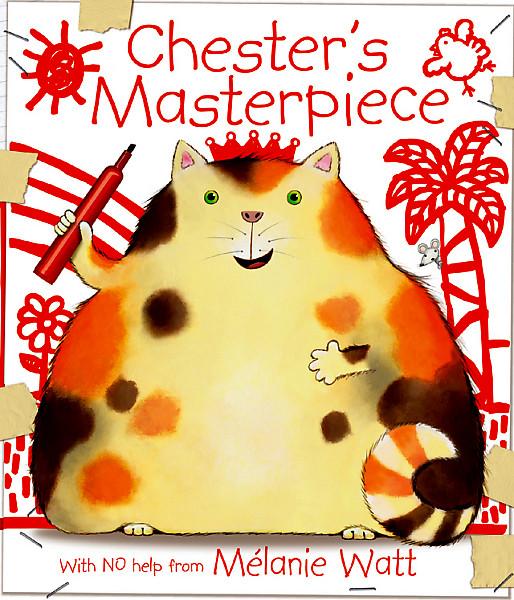
Chester's Masterpiece


Kirkus Review starred (January 15, 2010)
Chester, Canadian cat author extraordinaire, is back for a third self-aggrandizing volume without any help from Mélanie Watt. He has hidden her art supplies AND her computer mouse (which apparently tastes like chicken). He is in full control of this outing...unfortunately, she's found a pencil and some Post-it notes. Even though he tries to tell his story, she keeps interrupting to ask for her stuff back, while Mouse (who looks suspiciously like the human author) just keeps kibitzing. Still, Chester manages to tell the tale of Supercat saving the world from Dr. Meanmouse and one about Captain Cat surviving a whale attack, unlike poor Skipper Mouse. But then the unthinkable occurs: Chester's marker runs out of ink. Watt's chunky puss with delusions of grandeur (and writing skill) helms a sorta-meta-adventure sure to delight his fans. Chester appears in full watercolor while his own "illustrations" are in his trademark red marker. There are plenty of giggles along the way, and the author's revenge (not to mention Chester's hiding place for her supplies) will elicit gales of laughter. A must purchase, especially where the first two are loved. (Picture book. 4-8)